Child Safety on a Cruise Ship: Wristbands, Wandering and Meet Up Spots for Kids With Sensory Needs
This post may contain affiliate links. I may earn a small commission at no extra cost to you.
The quick answer
For child safety on a cruise ship, you need four things: a muster station wristband your child will tolerate, one fixed meet up spot, a “stop and stay” rule, and a quiet place to reset. Carnival, for example, says its youth staff give wristbands showing the muster station to all children 12 and younger, to be worn at all times. Your own plan does the rest, and you can set it up in about ten minutes.
Your child bolts, and you can't find them on a ship that big. That's the picture that wakes a lot of parents up at 3 a.m., and I get it.
I'm a mom of three boys with their own special needs and sensory needs. I don't take wandering lightly, and you shouldn't feel silly for worrying about it.
Here's the calm part. A ship has one way on and off, and the plan below is small enough to teach a child in a few days. You'll see how muster wristbands work, what to do when a band feels awful on a wrist, how to pick a meet up spot, and what to do if you can't see your child.
How safe is a ship for a child who wanders?
A ship is easier to watch over than most places families go. There's no parking lot and no busy street. You also never have to worry about a child walking out of a hotel lobby and into a city.
The flip side is that a ship is big, loud in places and full of doors. A curious child, or one who is trying to get away from a noisy room, can be out of sight in under a minute. That's the real risk, so that's what we plan for.
Here's a quick split of what the ship and the rules cover, and what stays with you:
| Built in | Still your job |
|---|---|
| Rails at least 42 inches above the deck on ships covered by US law | Keeping kids off chairs and rails, and never lifting a child up for a photo |
| A muster station wristband for kids (on some lines) | Making sure it stays on, and replacing it fast if it doesn't |
| Sign in and sign out at kids clubs | Telling staff what your child needs, in person |
| Crew in uniform all over the ship | Teaching your child who to go to |
On the railing: federal law sets a 42 inch minimum for ships it covers, and the Coast Guard's rule notes 42 inches is already the usual industry standard. A rail is a safety feature, not a babysitter. Climbable furniture next to it is the part to watch.
Cruise wristbands for kids: what they do and what they don't
“ID bracelet” makes people picture a name and a phone number. On Carnival, the band is closer to a hospital band. Carnival's page says it shows your muster station in bold letters, so crew know where to bring your child in an emergency.
The same Carnival page says parents are responsible for making sure the child wears it for the whole cruise. Carnival's Camp Ocean page adds that lost or broken bands can be replaced at Youth Facilities or Guest Services.
Other cruise lines have their own rules and their own kinds of bands, and some offer extras. I can only point you to a line's policy when I can link it, so check your own cruise line's help pages for your exact ship and sailing, or ask at booking.
Melinda's tip
Make your own contact card, because a muster band won't have your phone number on it. Write your name, your cell number and “please bring me to my parent,” and slip it in a pocket or on a breakaway lanyard. I'd skip putting your child's full name or cabin number where a stranger could read it from across the room.
What if your child hates wearing a band?
This one catches a lot of families. Plenty of kids with sensory needs can't stand anything on their wrist, and a stiff band can sour boarding day fast.
Here's the order I'd try things in:
- Practice at home. Have your child wear a soft wristband for ten minutes a day for a few weeks before you sail.
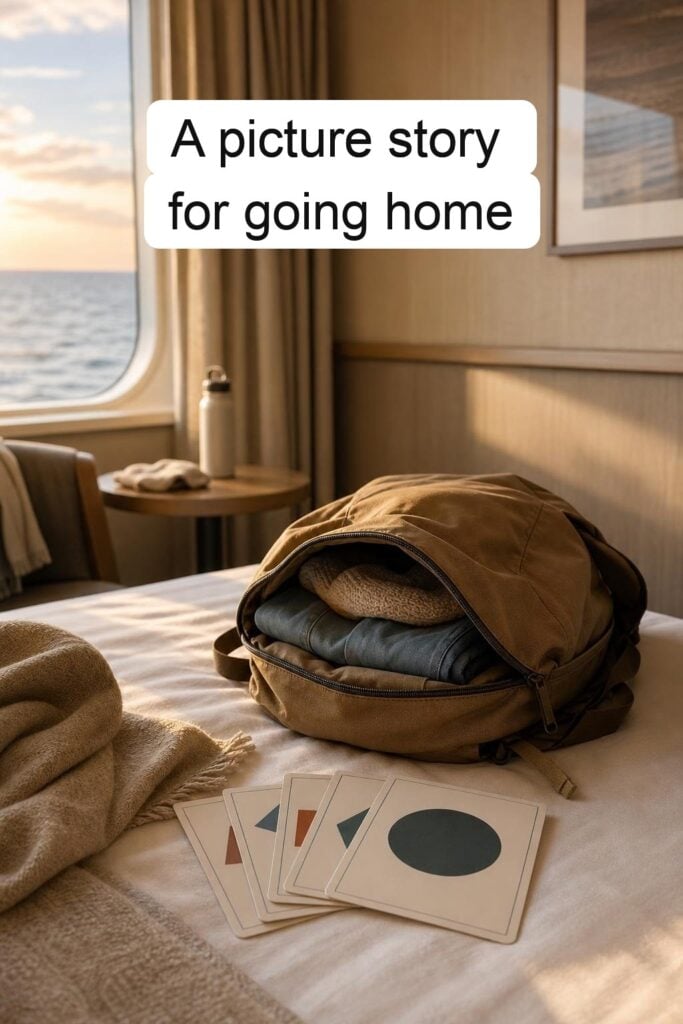
- Put it in the picture story. Add a page that says everyone wears a band on the ship. My guide to making a social story for a cruise shows how.
- Ask staff early. Tell the youth staff or Guest Services what bothers your child and ask what they allow. A different spot or a soft cover only works if the cruise line says yes.
- Get a spare. Bands get lost or chewed, so ask where replacements are handed out on day one.
Watch out
Don't cut a band off to make it more comfortable and then skip telling anyone. A band that's gone can't tell crew where your child belongs. Go get a replacement, even if it takes two tries.
How to pick meet up spots your child will remember
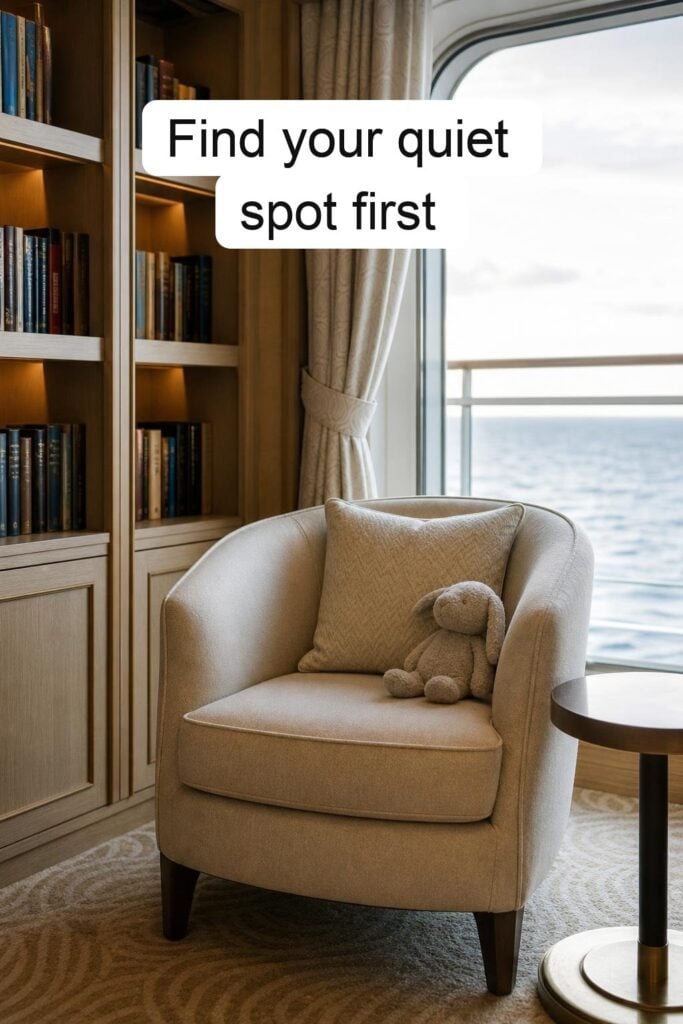
“Meet at the pool” sounds fine until you remember how many pools some ships have. A good meet up spot is one place you can describe in four words, and calm enough that your child won't want to bolt from it.
What to look for:
- It's on your own deck or near the main elevators, so it's easy to find again.
- It's quieter than the center of the ship, with fewer crowds and less music.
- A crew member is usually nearby. Guest Services (the front desk) is often the best pick.
- It has something your child can point to or remember, like a big window or a sculpture.
Choose a main spot and a backup. Walk to both together on day one and take a photo of each for your child's picture story. A quiet spot can double as a meet up spot, so my guide to quiet places on a cruise ship can help you choose.
Melinda's tip
Teach “stop and stay,” not “come find me.” A child who stays put is far easier for crew to find than one who keeps moving to look for you. Practice it like a game in the cabin and the hallway, and let your child “get lost” on purpose while you stay in sight.
Get the free Sensory Cruise Prep Pack
My help is always free to you. The cruise lines pay me, so you never do. The free Sensory Cruise Prep Pack gives you a calm place to start, and you can send me your dates if you'd like a hand matching a sailing to your family.
A simple cruise ship safety plan for families
You don't need a binder. You need one page and a few habits.
Before you sail
- Send the cruise line's special needs form. Here's how to fill it out and when to send it.
- If your child will go to the kids club, ask what staff do for kids who get overwhelmed. My kids club special needs guide lists what to ask.
- Build a picture story with your meet up spot, the wristband and crew uniforms.
- Take a clear photo of your child on boarding morning, so you have what they're wearing if you ever need it.
On boarding day
- Do the muster drill together. If crowds and loud announcements are hard, my boarding day and muster drill plan has calm ideas.
- Walk to your meet up spot and then to your cabin together.
- Tell your child who to ask for help: anyone in a uniform with a name tag.
- Warn your child about the ship horn. This calm plan for the horn covers it.
Every day
- Name one adult as the “eyes” in busy spaces, and swap every hour or so.
- Stay within arm's reach at pool edges, buffet lines and theater doors, where kids slip away fastest.
- Read the daily schedule for loud events and decide on a quiet backup ahead of time.
- Keep headphones in your bag. My guide to noise canceling headphones for kids on a cruise covers when they help most.
If you can't find your child
Stay calm and move fast:
- Check your meet up spot and the cabin first.
- Find the nearest crew member, say “I can't find my child,” and give a short description and what your child is wearing.
- Ask them to alert ship security or Guest Services right away.
- Keep one adult at the meet up spot in case your child goes back there.
Don't wait to see if it sorts itself out. Telling crew early costs you nothing.
Cabin, balcony and pool safety
The cabin is where wandering often starts, because the door is right there. A few small habits help.
- Door habits. Use the door latch whenever you're in the cabin. Before you buy any door alarm, ask the cruise line what is allowed on cabin doors.
- Balcony. Keep the balcony door locked when an adult isn't right there, and keep chairs and tables away from the rail. Furniture is how little climbers reach it. If your child climbs, an inside or oceanview cabin may feel calmer. See inside or balcony for kids with sensory needs.
- Rails. Never lift a child onto or over a rail, even for a photo.
- Pool. Stay in arm's reach of any child who doesn't swim well or who might bolt toward water. Don't assume a lifeguard is on duty, and ask your cruise line about its pool rules.
Watch out
Don't count on a tracking band or app alone, if your ship offers one. Batteries die, bands come off and signal can be patchy. A close adult, a meet up spot and the stop and stay rule do the real work.
Ports are busy and docks can be loud. If it's too much, staying on board is a fine choice. I explain how in is it okay to skip a port day. A short first sailing is also kinder on everyone, and I cover why in why a short first cruise is the calmest way to start.
Your questions, answered
What if my child refuses to wear the wristband?
Tell the youth staff or Guest Services early and ask what they can do. Carnival's help page says parents are responsible for making sure the band stays on, so it's worth asking before sailing day what is acceptable. Please don't just take it off and hope nobody notices.
What should I tell the crew about my child's sensory needs?
Use the cruise line's special needs form before you sail and tell youth staff in person at check in. Share what helps, what upsets your child, and how your child might react to noise or crowds. Short, plain notes work better than long ones.
Want a calmer first step?
Grab the free Sensory Cruise Prep Pack, or send me your dates and I'll help you think through the sailing. No cost. No pressure.
Sources I checked
Planning a cruise with a kid who gets overwhelmed?
I made a free Sensory Cruise Prep Pack for families with special needs and sensory needs. It has a picture story about the ship and a visual schedule you can print at home, so day one feels a little more familiar.

Free printable
A free 2027 cruise calendar for your wall
A real cruise destination for every month, plus a Ports of Call photo book. Print them at home.
Send me the free calendarPlanning your shore days?
Book highly-rated shore excursions and port tours before the best ones sell out.
Find shore excursions on Viator →As a Viator affiliate, I earn a small commission from qualifying bookings, at no extra cost to you.
Cruise Packing Essentials
The little things that make cruising smoother: the gear I recommend to every traveler before they sail.
As an Amazon Associate, I earn from qualifying purchases, at no extra cost to you.